
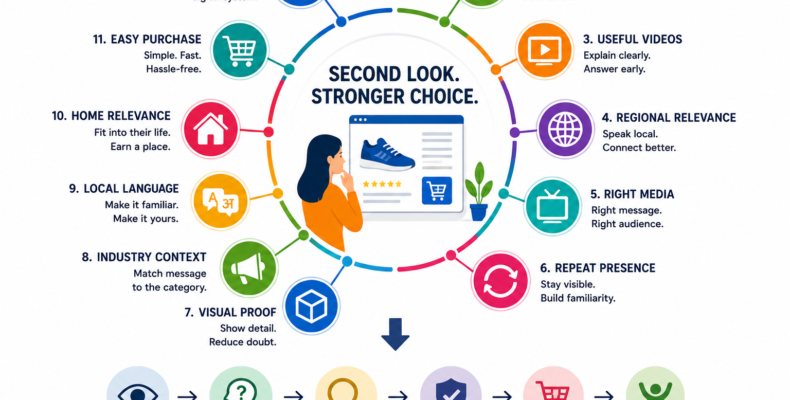
Most advertising is built around the first look.
A customer sees a product on social media, notices a billboard, watches a short video, hears a brand name on television, comes across a retail display or sees an event announcement. In that moment, the brand has done something important: it has earned attention.
But attention is not the same as confidence.
The real question is what happens when the customer looks again.
Do they understand what the product does? Can they see why it is different? Does the company feel credible? Is there proof that the brand is active in the real world? Does the message make sense in their language and market? Can they find the product easily when they are ready to buy?
The second look is where many businesses lose momentum.
A campaign may be strong enough to create curiosity, but the website may be unclear. The product packaging may look good but the online listing may not explain the benefit. A local campaign may create awareness, but there may be no proof that the brand understands the market. A customer may see a product repeatedly but still hesitate because the company feels too new, too vague or too difficult to trust.
The strongest Indian brands do not focus only on making a first impression.
They build a system that makes every second impression stronger than the first.
They use digital strategy, real-world proof, product storytelling, regional communication, relevant media environments and clear purchase journeys to make the customer feel progressively more confident.
That is how curiosity becomes consideration.
And consideration becomes action.
A Brand Needs a System Behind the Campaign
A campaign can create demand, but it cannot carry the entire customer journey on its own.
A person may click an advertisement, visit a website, fill out a form, watch a product video, request information, compare options, return later and eventually make a purchase. If every one of these stages feels disconnected, the brand begins losing trust.
This is why growth should not be treated as a collection of individual activities.
A business needs a clear system that connects strategy, technology, customer data, sales follow-up, content, media visibility and purchase experience.
A thoughtful digital consulting approach can help a company move beyond isolated campaigns and begin building a more connected growth structure.
The important question is not simply whether a business is getting leads.
The better question is whether the business understands what happens after the lead arrives.
Does the customer receive the right follow-up? Does the sales team know what content the person has already seen? Does the website help the visitor continue naturally? Does the brand understand which message brought the customer in? Does the company know which market, product or offer is creating the strongest response?
A brand that connects these touchpoints feels more reliable.
The customer should not feel like they are moving between different companies each time they interact with the business. The same clarity should continue from advertisement to website, from website to sales conversation and from sales conversation to purchase.
Real-World Proof Makes a Brand Feel More Established
Digital campaigns can make a business look active.
Real-world experiences make it feel real.
For many customers, partners, distributors, retailers and investors, confidence grows when they see the company operating visibly in the physical world. A strong launch event, product reveal, dealer conference, customer gathering, summit or industry interaction can become proof that the brand has momentum beyond an online campaign.
The stage matters more than many businesses realise.
It is not only a platform for speakers. It is a visual signal of preparation, confidence and seriousness. A brand that presents itself clearly in a well-designed environment makes the product story easier to believe.
A professionally planned stage design and fabrication setup can help businesses create a stronger visual environment for launches, conferences, award nights, town halls, dealer meets and leadership events.
The customer may not consciously study the stage, the lighting or the visual structure.
But they notice whether the experience feels organised.
A weak event setup can make even a strong product look unfinished. A well-executed environment can make a new business feel more established, more visible and easier to trust.
More importantly, the event becomes an asset.
The photographs, founder clips, product demonstrations, partner interactions and customer moments can continue working across social media, sales presentations, website pages, press material and local campaigns.
A single event can create months of proof.
Product Videos Should Answer Questions Before They Become Objections
Customers rarely reject a product because they know too much.
They reject it because they do not know enough.
They may not understand the use case, the size, the quality, the process, the value or the difference between one option and another. They may wonder whether the product will suit their routine, their business, their family, their store, their budget or their market.
A product video can reduce much of that uncertainty.
Instead of simply showing a product from attractive angles, a strong video can explain what problem it solves, how it works, who it is for and why it deserves a closer look.
A clear product video editing workflow can help businesses turn product shoots, demonstrations, customer footage and founder explanations into content that supports both awareness and conversion.
For a consumer brand, this may mean showing the product in a believable everyday setting. For a B2B company, it may mean demonstrating the process, quality or technical benefit. For a retail business, it may mean helping the customer understand the product range. For a healthcare, wellness or education brand, it may mean reducing uncertainty about what happens after the first interaction.
The key is not to make the video longer.
It is to make the message clearer.
A customer who understands the product before speaking to a sales representative is more likely to begin the conversation with confidence rather than hesitation.
Conversion Is Not Only About Selling. It Is About Reducing Doubt.
Many organisations receive attention but struggle to turn it into action.
The customer may visit the page, watch the video, read the story or engage with the campaign, but still not complete the next step. In some cases, the problem is not interest. It is friction.
The message may be unclear. The form may feel too long. The call to action may be weak. The customer may not know what will happen after they submit their details. The process may feel uncertain. The product may not look trustworthy enough to justify the decision.
These same issues affect both commercial brands and mission-led organisations.
The way a nonprofit prepares a donation journey offers an important lesson for businesses. A person does not contribute only because they care about the cause. They contribute when the process feels clear, credible and easy to complete.
A strong donation-page and gateway setup shows how attention must be supported by clarity, trust signals, simple actions and a visible reason to continue.
The same principle applies to a product purchase, distributor enquiry, consultation booking, event registration, retailer lead or partnership conversation.
The customer needs to know what they are doing, why it matters and what happens next.
The easier a brand makes those answers, the more likely people are to take action.
Regional Relevance Is a Form of Proof
A new brand can enter a market with a polished campaign and still feel distant.
Customers often want to know whether the company understands their city, their language, their daily routines and the kind of decisions people in that market actually make.
This is why regional relevance should never be treated as a translation exercise.
A campaign may use the same central brand promise in every state, but the expression of that promise needs to feel natural to the audience. The examples, language, media environment, visual references and timing should make sense in the market.
For brands exploring a multilingual and region-sensitive audience, a focused TV9 Bangla campaign in Assam demonstrates how a business can think about language, regional identity and local communication rather than relying only on generic national reach.
A regional campaign works best when it does more than replace English copy with another language.
It should answer a local question.
Why is this product useful here? Why does this service matter in this city? Why should this audience care now? How does the company fit into the everyday world of the customer?
When a business gets this right, it begins feeling less like an outsider.
And when a brand feels local, it becomes easier for customers to introduce it to family members, friends, colleagues, retailers and business partners.
The Second Look Often Happens on Streaming Platforms
The first interaction may happen through a short social-media video or a quick advertisement.
But for many customers, the second look happens while they are watching longer-form content, browsing entertainment platforms or spending time in a more relaxed environment.
This is where the customer has more time to absorb a story.
A product may not need a full sales pitch. It may simply need a better context. A family may need to see the brand more than once. A consumer may need a stronger visual reminder. A premium service may need a story that makes the offering feel more relevant.
A well-planned ZEE5 advertising strategy can help businesses think about how video, streaming, entertainment and digital visibility can support customer familiarity over time.
The value of a platform like this is not only visibility.
It is attention quality.
Customers are not always in the same mindset when they see a brand. A person scrolling through a busy social feed may only give a message a few seconds. A person watching long-form content may be more open to a story, a product demonstration, a lifestyle message or a more emotionally connected campaign.
The strongest brands adapt their communication to the moment.
They do not try to say everything in one format.
Frequency Helps Customers Feel Safer About New Brands
A customer often chooses what feels familiar.
This does not always mean they choose the biggest company. It means they feel more comfortable with brands they have seen repeatedly in relevant places.
A new brand can become less risky when customers encounter it more than once. They may see a launch message, then a short reminder, then a local media placement, then a product video, then a retailer mention, then a marketplace listing.
These moments create memory.
A recurring on-screen format such as L-band advertising can help businesses stay visible in a way that supports recognition over time.
The goal is not to overwhelm people with the same advertisement.
The goal is to make the brand easier to remember.
A customer may not act after seeing the first message. But the second or third appearance can make the company feel more familiar. Later, when the person needs the product, service or information, the brand name may come to mind first.
That is why frequency matters.
It gives the customer time to move from recognition to comfort.
Visual Detail Helps Products Compete on Small Screens
Product discovery is increasingly happening on mobile screens.
The customer may not first encounter a product on a retail shelf. They may see it in a social-media post, a marketplace listing, a quick-commerce grid, an app card, a website thumbnail or a digital catalogue.
This means the product has to work visually at multiple sizes.
It must look convincing in a large campaign image, but it must also remain clear when the customer sees it as a small thumbnail. The branding, pack, label, benefit and visual hierarchy all need to make sense immediately.
A well-developed 3D product rendering approach can help businesses create product visuals that remain consistent across advertising, retail, e-commerce, packaging, product pages and digital catalogues.
The advantage of 3D is not only flexibility.
It is consistency.
A business can show multiple colours, variants, materials, angles, bundle combinations and lifestyle settings without losing control over the brand presentation. This can be especially useful for consumer products, home brands, beauty products, packaging-led businesses, technology devices and premium product categories.
The customer should not see one version of the product in advertising and a completely different version during the purchase journey.
The visual story should stay connected.
Industry Context Can Make a Brand Feel More Relevant
Not every customer responds to the same kind of communication.
A food brand, finance company, education provider, real-estate developer, healthcare business, technology platform and consumer service all have different customer journeys. They require different kinds of proof, different levels of explanation and different media environments.
This is why brands should not begin media planning by asking only which channel has the largest reach.
They should ask what type of environment suits the category.
An industry-first planning approach can help businesses make better choices about message, format, language and timing. A broader industry planning guide for regional campaigns can help companies think about how media relevance changes from one category to another.
A healthcare business may need education and reassurance before it needs a hard sales message. A real-estate business may need credibility, local location detail and family relevance. A consumer brand may need repeated household visibility. A finance brand may need clarity and seriousness. A technology company may need a founder-led story or a product explanation.
The more closely the communication matches the customer’s real decision, the more likely the brand is to earn a second look.
Hindi Markets Require More Than Mass Reach
Hindi-speaking markets include a wide variety of customers, cities and buying patterns.
A product that performs well in Delhi may need a different message in Lucknow. A campaign that works in Jaipur may need another kind of proof in Indore. A family-oriented category may need household familiarity. A premium product may need education. A retail offer may need stronger price communication. A B2B service may need more authority and case-study proof.
That is why audience segmentation matters.
A broad Hindi industry-media planning framework can help businesses understand how different sectors need different combinations of television, digital, print, radio, cinema, OTT and local market communication.
The main lesson is simple.
Reach is not enough.
The business needs to appear in a way that makes sense for the customer, the category and the city.
A brand should not ask only how many people it can reach in Hindi markets.
It should ask what type of customer it wants to help, what question that customer is asking and what proof will make the brand easier to trust.
Maharashtra Needs Product Stories That Feel Familiar at Home
Maharashtra is a major market for food, wellness, retail, finance, healthcare, education, consumer products and service brands.
But it cannot be treated as one single audience.
Mumbai, Pune, Nashik, Nagpur, Thane, Navi Mumbai, Kolhapur and other cities have different consumer behaviours, local influences and purchase triggers. Marathi language communication can create relevance, but the campaign still needs to feel useful inside the household.
A broader Marathi industry-media planning framework can help brands think about the relationship between category, audience, regional media and product relevance.
The product story should not feel copied from another market.
A food brand may need to show familiar household moments. A wellness company may need to create believable routines. A financial product may need to feel practical and understandable. A retail business may need local availability and strong seasonal timing. A healthcare service may need trust signals that help family decision-makers feel more comfortable.
A customer is more likely to choose a brand when they can imagine it fitting naturally into their own life.
The Last Step Must Feel Easier Than the First
A customer may see the campaign, recognise the product, understand the value, trust the brand and finally decide to buy.
But if the final path is confusing, the business can still lose the sale.
This is especially important for FMCG, food, beverage, beauty, wellness, personal care, household and consumer brands. The customer often decides quickly. They may be browsing through a marketplace, checking a product card, comparing prices or ordering through a fast-delivery platform.
The product must be easy to understand in seconds.
A useful guide on quick commerce versus e-commerce for brands highlights an important distinction: customers behave differently when they are making a planned online purchase compared with a fast, mobile-first quick-commerce decision.
On one platform, they may read more details, compare more options and take time to decide.
On another, they may react instantly to a thumbnail, pack size, price, product benefit and availability.
Brands need to design for both.
The product image should be clear. The title should make sense. The packaging should be readable. The variant should be easy to identify. The offer should be simple. The product should be available where the customer expects it.
The campaign creates the desire.
The purchase journey must make acting on that desire easy.
Final Thoughts
The first look earns attention.
The second look earns trust.
That is why the strongest brands do not stop at awareness. They build a connected experience that keeps making the customer more comfortable every time they encounter the company.
They create a clear digital system. They show up in the real world. They explain products through useful video. They make action simple. They communicate naturally in regional markets. They build familiarity through repeat visibility. They keep product visuals consistent. They choose media based on category relevance. They understand local audiences. And they make the final purchase feel effortless.
The goal is not simply to make customers notice the brand.
The goal is to make them feel increasingly confident that they are making the right choice.
That is how curiosity becomes customer confidence.